Welcome to Mymeteorite!
Space love. Baykonur, Kazakhstan. Nov 2008.
News about starts of the rockets, new companions and flights of the person in space caused make me a pleasant sad. The space flight the very courageous and impossible desire. Even money in that case does not solve a question. Certainly it would be desirable to take a look at least of it, but I did not think at all of it seriously. I communicated with one lovely woman about meteorites and to the magic case, I have been invited to the rocket start. There was two weeks until start, and there was no time to think.
The first trip has taken place on November, 12th, 2008, on start of a rocket the Union-TMA with two cosmonauts and one space tourist Richard Gerriot. When I have seen this start, my understanding of laws of physics has changed. I have received many impressions when I have seen a space shuttle "Buran". It was in a cosmodrome "Baikonur" museum. It did not fly, but was an exact copy of that shuttle which in 1988 has made the real progress of the Russian astronautics.
The same day in a museum there was a first copy of a meteorite and the history of a personal collection of meteorites in a museum has begun. It was very surprising that till now in a museum where all breathes by the space, there was no space mineral. I have got many hot impressions of dialogue with museum staff, we had so to say a scientific exchange.
The second trip was in November, 2009 it has been connected with start of a carrier rocket the Progress which mission was, to deliver cargo to MKS station. It is other rocket, but it has not brought impressions. Remains desire to look on Proton start. This one is much more powerful. There was a new meteorite in a museum collection. It become fast the biggest collection in Kazakhstan.
Real Hustory began in India. Crater Lonar. Feb 2009.
India, state Maharashtra, province Buldana, meteoric crater of Lonar (Lonar crater), February, 2009.
Co-ordinates: 19°58′36″N 76°30′30″E (19.976667, 76.508333). Approximate time of formation of a crater 50000 years ago. Diameter of 1800 metres, depth of 132 metres, water in the formed lake salty also has density of 10,7 gr./l.
Travel to a crater of Lonar was at a loss absence of a railway communication with this place. From the nearest station three hours of driving by the bus. The present Indian settlement where each child points a finger or waves the handle as a sign of a greeting. This attention very quickly bothers, but the purpose has justified means. In the middle of plain there is almost equal crater on a circle, it is not interesting to local residents, in near trees peacocks are grazed.
Despite a rotten smell of water, it was very interesting to survey this place. We had not to search the meteorite rests, to me have explained that some time ago here all was surveyed very carefully by representatives NASA and apertures in stones reminded of their scientific searches. The holes are made by special drills for the purpose of extraction of stone samples of local breeds and the further studying in laboratory. The top circle of a crater, total of holes more than 100 pieces is carefully surveyed.
There are a pieces of temples different time the constructions around the lake all these facts speaking about the religious relation to this place of local residents. It was not possible to find out exact time of construction. On a northeast part of a crater, there is an operating temple. Through it or from under it the stream of fresh water which runs into a crater flows.
It provides lake and surrounding flora with a moisture, being some kind of a life source, creating a microcosm in the limited diameter of a craterI sure that, in December this crater would present to scientists many new opening without this stream, remaining simultaneously lifeless space. Thanks to it, the lake bottom remains a riddle for the researcher and inspection without the special equipment is not possible.
Even to the usual inhabitant this place seemed to be mystical and mysterious. The delight varied a fright from each rustle, after that time to come to the senses was required. Local residents threw ironic sights on us. It seemed to me, they know a little bit more about this place, but in these places you could not meet many English-speaking Hindus. Expedition on a crater has given answers to many my questions but when I left the new questions have appeared again.
I miss about this time and history about my transformations. It was most intensive and fast period of my live.
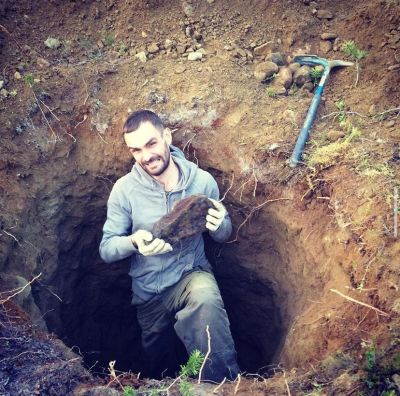
First Expedition in my live. Sweden, Muonianalutsa. May 2010.
Expedition in search of a meteorite Muonionalusta under leadership of the skilled geologist - the expert in the meteorites, V.N.Stepakov has taken place in the end of May, 2010 and has lasted ten days.The action passed with four participants two of them specially arrived from Germany for that case. During this time joint efforts it was revealed three samples in gross weight of 40 kg. Average depth samples was levelled one metre.
Lately there are many geologists and unprofessionals from different countries worked around the place falling. The local population cannot indifferently look at an event they takes part actively in searches of fragments of accident of space scale.
If to consider that the search zone was stretched on 75 km., To tell the truth, it is possible to consider our find as one of the most modest. The basic weights have been found to us. For example one found sample weighed 1800 kg., also it has been taken by the Russian team couple of years ago.
The search passed at the cross-country conditions in tundra near a polar circle. We had a good luck with weather, and insects have not woken up yet and did not intrude upon our leisure. Reindeers indifferently looked at us, and left away.
Expedition to Zhamanshin meteorite crater, Kazakhstan. June, 2013.
An expedition to Zhamanshin meteorite crater, June, 2013. Irgiz district, Aktobe region, Republic of Kazakhstan. The purpose of the expedition to the crater was searching for impact melt rocks, formed during meteorite impact, as no meteorite itself was left after the impact. According to a local belief, "Zhamanshin" is translated as a "death trap", or, as the locals told us, "the valley of death." The coordinates of Zhamanshin crater are as follows: 48°24'00"N 60°58'00"E. The crater of Zhamanshin was formed as a result of impact of a meteorite of about three hundred meters. The crater diameter is 7 km, the depth - 300 meters.
It is difficult to assume unequivocally the age of the crater; according to various sources, it ranges from one million years to 50 million years. The impact structure itself was formed at a temperature of about 1700 degrees Celsius. It looks like solidified layers of brown and light brown volcanic lava. Finding of bubbled quartz or lechatelierite - SiO2 - was of particular interest. Lechatelierite is usually found in places of meteorite impact, places with volcanic activity and places with high thunderstorm activity. Tektites, air-borne impact structures, can also be found near the crater. This refers Zhamanshin crater to the category of rare ones, as in most cases either tektites or impactites are found in impact craters.
Join Our Team
We're always looking for talented individuals to join our team. Check out our career opportunities today and see if we're a good fit for you!
Contact Us
Have questions or comments? We'd love to hear from you. Contact us today and we'll get back to you as soon as possible.
Learn More About Mymeteorite
Want to know more about our business? Check out our About Us page for more information about our mission, values, and team.